
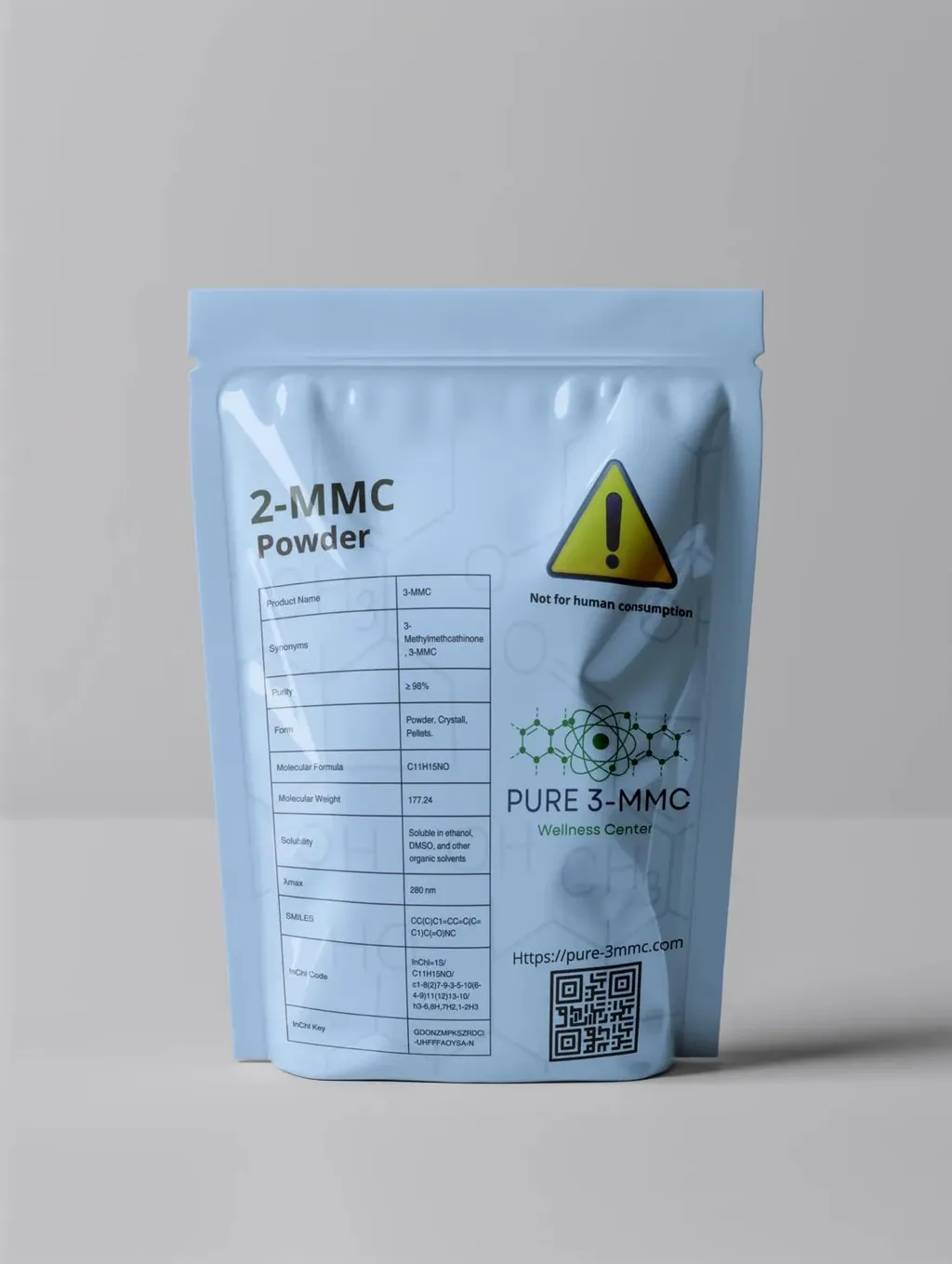
Introduction to 2-MMC and Emerging Psychoactive Substances
2-MMC, or 2-methylmethcathinone, belongs to the broad family of synthetic cathinones. These substances are chemically related to cathinone, a naturally occurring compound found in the khat plant. Synthetic cathinones have received attention from researchers because their molecular structures can be modified in numerous ways, creating compounds with different pharmacological properties.
The appearance of substances such as 2-MMC demonstrates how quickly developments in organic chemistry can produce new psychoactive compounds. A newly identified substance may become known before researchers have completed comprehensive studies concerning its pharmacology, toxicology, metabolism, and long-term effects. This gap between chemical availability and scientific understanding is one of the major challenges associated with new psychoactive substances.
The term research chemical is sometimes used broadly to describe compounds that have limited regulatory or medical history. It is important to understand that this terminology does not indicate that a substance has been approved for human use or that its safety has been established. Instead, it generally reflects the fact that scientific information may still be developing.
For this reason, discussions surrounding 2-MMC should distinguish between verified scientific evidence and claims based on personal experiences or commercial descriptions. A chemical name can identify a molecular structure, but it cannot by itself establish safety, predictable effects, or suitability for human consumption.
Chemical Structure and the Synthetic Cathinone Family
Synthetic cathinones share structural characteristics with cathinone, but individual compounds can contain different substitutions that alter their molecular behavior. Even relatively small structural changes can influence how a substance interacts with biological targets.
2-MMC is part of the methylmethcathinone group. Other compounds within the broader synthetic cathinone family have been studied to different degrees, but information about one analogue should not automatically be treated as evidence concerning another.
This is a fundamental principle in pharmacology. Structural similarity can provide researchers with useful hypotheses, but it does not guarantee identical pharmacological activity. Differences in molecular structure can affect transporter affinity, metabolism, potency, duration, and the formation of metabolites.
Consequently, scientific investigation of 2-MMC requires compound-specific evidence. Researchers may compare it with structurally related cathinones to understand possible mechanisms, but those comparisons should remain clearly identified as comparisons rather than definitive conclusions.
Chemical analysis is another essential part of the research process. Laboratories may use chromatographic and spectrometric techniques to identify compounds and distinguish them from related analogues. Accurate identification becomes particularly important when several substances have similar names or molecular structures.
Pharmacological Questions Researchers Investigate
Synthetic cathinones can influence monoamine neurotransmitter systems, including dopamine, norepinephrine, and serotonin. These neurotransmitters play important roles in the regulation of mood, alertness, motivation, attention, cardiovascular activity, and other physiological processes.
The precise pharmacological profile of a synthetic cathinone depends on its molecular structure. Some compounds can promote neurotransmitter release, while others can interfere with reuptake mechanisms. The balance between these activities can influence the overall physiological response.
For 2-MMC, researchers need to determine how it interacts with relevant transporters and receptors, how quickly those interactions occur, and how the compound is metabolized. Laboratory studies may provide information about these mechanisms, but translating laboratory findings into human outcomes requires additional evidence.
Pharmacological research also examines concentration-response relationships. Understanding how biological activity changes with increasing concentrations can help researchers evaluate potential toxicity. However, establishing a complete safety margin requires extensive evidence and cannot be inferred simply from a laboratory measurement.
Another important issue is metabolism. Once a compound enters the body, enzymes can transform it into metabolites. Some metabolites may have their own biological activity, meaning that understanding the parent compound alone may not provide a complete picture of its effects.
Potential Toxicological Concerns
The toxicology of emerging synthetic cathinones is an important area of scientific investigation. Because these compounds can influence stimulant-related biological pathways, researchers pay particular attention to cardiovascular, neurological, and psychological effects.
Possible acute reactions associated with stimulant-type substances can include increased heart rate, elevated blood pressure, sweating, agitation, anxiety, tremor, insomnia, and changes in body temperature. Severe toxicity involving stimulant compounds can sometimes result in seizures, serious cardiovascular abnormalities, extreme agitation, or impaired consciousness.
These observations should not be interpreted as a definitive description of the specific risk profile of 2-MMC. Available evidence may be insufficient to determine the frequency or severity of individual outcomes. Instead, these concerns demonstrate why compounds in this chemical family require careful toxicological assessment.
Individual factors can also influence adverse reactions. Existing cardiovascular conditions, mental-health vulnerabilities, sleep deprivation, interactions with medications, exposure to other psychoactive substances, and unknown chemical concentrations can all complicate outcomes.
Polysubstance exposure is particularly challenging for toxicologists. If multiple compounds are present, identifying which substance caused a particular physiological effect can be difficult. This is one reason why controlled laboratory research and carefully documented clinical observations are important.
The Importance of Laboratory Analysis
Reliable chemical identification is essential when studying any emerging psychoactive substance. Laboratory analysis can determine whether a sample contains the compound that it is claimed to contain and whether additional substances are present.
Modern analytical laboratories can use methods such as gas chromatography, liquid chromatography, and mass spectrometry. Depending on the analytical objective, researchers may also use nuclear magnetic resonance spectroscopy or other complementary techniques.
These methods are valuable because physical appearance is not sufficient to establish chemical identity. Two powders may look almost identical while having completely different molecular compositions. Conversely, the same compound can appear differently depending on its formulation and physical state.
Laboratory analysis also supports forensic science and public-health surveillance. When previously unidentified compounds are detected in biological or seized-material samples, laboratories can characterize them and communicate findings to relevant scientific and public-health networks.
Independent testing is especially important when evaluating claims concerning purity. A statement that a material contains a particular chemical does not automatically demonstrate its composition. Even a correctly identified compound can contain impurities or other substances that affect its biological behavior.
Therefore, analytical chemistry provides one part of the evidence base, while toxicology and pharmacology provide additional information about biological effects.
Why Online Product Descriptions Require Careful Evaluation
Information about substances such as 2-MMC is widely available online, but the quality of that information can vary substantially. Commercial pages may describe chemical characteristics using language that sounds scientific without providing independent evidence.
For example, statements about purity, quality, expected effects, or safety should be evaluated according to their evidence rather than their wording. A professional-looking website does not necessarily mean that the information has been independently verified.
The same principle applies to user reviews and discussion forums. Personal experiences may provide clues for researchers, but they cannot establish a universal effect. People differ in physiology, health status, genetics, tolerance, medication use, and environmental circumstances.
Search engines can also amplify repeated claims. If several websites publish the same description, readers may assume that multiple independent sources support it even when the text originated from one source.
Researchers and students should therefore prioritize peer-reviewed publications, toxicology reports, forensic research, official health information, and recognized scientific databases. These sources generally provide greater transparency concerning methodology and limitations.
The website europeresearchchem.com, for example, should not be treated as a substitute for independent scientific literature when evaluating questions about pharmacology or health risks. Commercial information and scientific evidence serve different purposes and should be assessed accordingly.
Legal and Regulatory Issues
The regulatory status of emerging psychoactive substances can differ significantly between countries. Governments may control individual compounds, groups of related substances, or broader categories of psychoactive chemicals.
Because legislation can change, information found in an old article may no longer accurately describe the current legal situation. A compound's availability through an online source does not establish that possession, importation, distribution, or use is lawful in a particular jurisdiction.
Researchers studying 2-MMC should therefore separate chemical information from legal information. Chemical databases can explain molecular structures, while official government and regulatory sources are more appropriate for determining current legal classifications.
International differences also make regulatory research complicated. A compound may have different legal treatment in different jurisdictions, and some countries may use analogue or psychoactive-substance laws that cover compounds beyond those explicitly named in legislation.
Anyone seeking authoritative information should consult current government sources relevant to the jurisdiction involved rather than relying exclusively on commercial websites or online discussions.
Research Gaps and the Need for Better Evidence
One of the central issues surrounding 2-MMC is the potential lack of comprehensive independent research. Important questions may remain concerning metabolism, toxicity, pharmacological activity, interactions, and long-term health outcomes.
Early evidence can come from several sources, including laboratory experiments, forensic detections, clinical observations, poison-center reports, and epidemiological research. Each source has advantages and limitations.
Laboratory experiments can reveal mechanisms but may not reproduce real-world human exposure. Clinical cases can provide important information about adverse effects but may involve unusually severe circumstances. Epidemiological studies can identify broader patterns but may be affected by uncertainty about the exact substance involved.
Combining different forms of evidence is therefore essential. Researchers can compare laboratory findings with clinical observations and population-level data to develop a more reliable understanding.
Long-term surveillance is also valuable because emerging substances can change rapidly. New analogues may appear while older compounds become less common. Continuous analytical monitoring allows scientists and public-health authorities to detect these changes.
A Scientific Approach to Understanding 2-MMC
The study of 2-MMC illustrates the broader importance of evidence-based research into new psychoactive substances. Understanding an emerging compound requires more than knowing its name or chemical formula. Researchers need to examine its molecular structure, pharmacology, metabolism, toxicology, analytical characteristics, and potential interactions.
Scientific uncertainty should be communicated clearly. When evidence is incomplete, responsible researchers should avoid presenting assumptions as established facts. A lack of evidence for harm is not the same as evidence of safety, just as the existence of theoretical risks does not establish that a particular outcome will occur.
This distinction is especially important when information is presented online. Readers should consider the source, methodology, independence, and quality of supporting evidence before accepting claims about an emerging compound.
2-MMC remains part of a wider scientific and public-health discussion surrounding synthetic cathinones and new psychoactive substances. Continued research can improve understanding of these compounds, strengthen analytical detection, and help healthcare professionals and policymakers respond to emerging risks.
The broader lesson is straightforward: chemical identity, pharmacological activity, and human safety are separate questions. Each requires appropriate evidence. A careful scientific approach therefore focuses on verified data, recognizes uncertainty, and avoids making conclusions that available research cannot support.